Recognition & Rewards
Building a system that turns contribution into lasting engagement
I led the evolution of Yelp's Recognition experience from a temporary reward moment into a lasting part of the product. I designed where achievements live, how they build contributor pride, and how they help readers evaluate credibility. That work became a foundation for a broader reward strategy that now includes Streaks.
Role
Lead Product Designer
Scope
Contributor motivation, credibility signals, and reward strategy
Team
Contributions and Content Design
Timeline
2023–present
Impact at a Glance
~5K
additional reviews per month on iOS after contextual Recognition launched
+1.7%
increase in sessions where users visited another contributor’s profile
✓
A permanent home for Recognitions across mobile and web
✓
A reusable foundation for Yelp’s evolving contributor reward system


The Opportunity
Contribution often ended without a meaningful return
People invest time sharing experiences on Yelp, but the product did not consistently show what that effort added up to. Feedback appeared through disconnected moments such as reactions, compliments, badges, or status. Some disappeared quickly. Others lacked enough context to feel meaningful.
This left two gaps. Contributors could not easily revisit what they had accomplished, while readers had few signals for understanding a reviewer's experience in a particular category.
The larger opportunity was to build a reward system that helps contributors understand what they added, why it mattered, and what their work is becoming over time.
Starting from a validated idea
Before I joined the project, another designer created an experiment that rewarded people for writing multiple reviews in a category. The experiment showed that Recognition could motivate contribution:
- Review contribution increased approximately 6–8% compared with the control
- About 20% of people who received the Recognition message earned one
- Reviews written toward Recognition showed stronger quality signals
The test proved the motivational value, but the experience ended after the reward moment.
- Contributors could not return to their Recognitions
- Readers never saw them in the context of a review

Show the potential Recognition user could earn, leverage the momentum for continuous contribution

Earn a Recognition, celebrate moment
I inherited the project at that point and led the next phase: turning a successful experiment into a coherent, lasting product experience.
The Design Challenge
One system had to serve contributors and readers
Recognition needed to create value for two audiences with different needs.
For contributors, it had to feel like meaningful acknowledgment rather than a decorative badge. People needed a place to revisit their achievements, understand what they represented, and connect them to the reviews that earned them.
For readers, Recognition needed to work as a fast credibility signal without adding noise to an already dense review surface. Readers also needed a way to verify the signal by exploring the contributor's related reviews.
This dual-audience tension shaped the sequence of the work. We first established a permanent home for contributors. We then brought Recognition into the reading experience once it had enough context to feel credible.
Building the Recognition Experience
Milestone 1
Give Achievements a Permanent Home
The first milestone placed Recognition in Me Tab, where contributors manage their identity and activity on Yelp. The existing page already separated measurable impact, such as views and reactions, from achievements such as Elite status and legacy badges.
I explored placing Recognition inside the Impact section, but that blurred two different ideas.Impact described what happened because of a contribution. Recognition represented an Achievementearned through a body of work.
I kept Recognition within Achievements, positioned it directly below Yelp Elite, and moved the section higher on the page for better discovery. The Recognition details experience showedwhen each achievement was earned, how many related reviews the contributor had written, and the reviews connected to it.


Why it mattered
Recognition became durable. Contributors could return to their achievements and see how individual reviews accumulated into visible interests and experience.
Milestone 2
Make Recognition Useful in the Reading Experience
Once contributors had a permanent home for Recognition, the next step was to show it where readers evaluate reviews.
The business-page user passport had limited space and already contained identity, status, and contribution information. I explored placing Recognition beside the username and combining it with the existing statistics. Both directions created too much competition and made the signal difficult to interpret.
The final design replaced the statistics row when a contributor had a Recognition relevant to that business. It showed the category and the number of reviews behind it. On web, readers could open the contributor's related reviews and evaluate the experience supporting the Recognition.


Why it mattered
The design connected acknowledgment with evidence. Recognition rewarded contributors while giving readers a relevant signal at the moment they were deciding whether to trust a review.
System Design
Exploring How Recognition Stays Current
As part of the reader-facing work, I explored how Recognitions could reflect recent activity without erasing what contributors had already earned.
I reframed the experience around keeping a Recognition active. Contributors could still see what they had earned, while writing another relevant review restored its public visibility. This preserved the integrity of the reader-facing signal without erasing the contributor's history.
Why it mattered
The system could encourage renewed contribution while respecting work people had already completed.

If user has not written any reviews of the same category for >1 year, the Recognition will show as inactive, prompt user to write a new review to activate it

For an inactive Recognition, user will still see them in their Recognition page, but it will not show up as a reviewer credential in review feed
Outcome
Recognition created value beyond the reward moment
The Me Tab experience gave contributors a permanent record of their Recognitions across mobile and web. Showing relevant Recognitions alongside reviews then connected those achievements to the reading experience.
In a large global experiment, the business-page experience produced measurable results on iOS:
- Approximately 5K additional reviews per month at full rollout
- A 1.7% increase in sessions where users visited another contributor’s profile
The larger lesson was that rewards can create value for more than the person receiving them. When grounded in visible evidence, Recognition can support motivation, contributor identity, and reader trust within the same system.
The Next Evolution
From recognizing achievements to supporting consistency
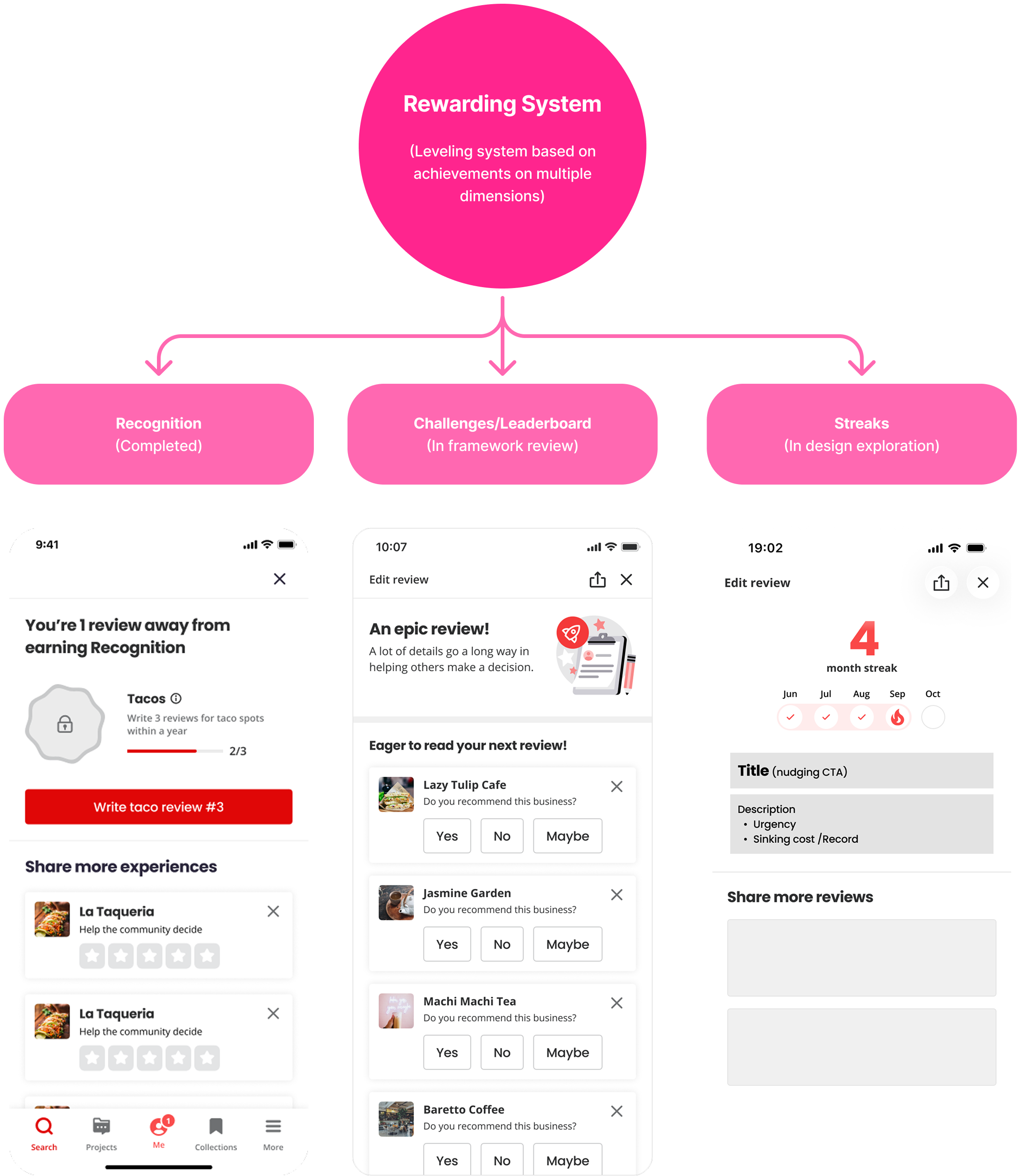
Recognition became one expression of a broader contributor reward strategy. Product led the broader reward strategy. I partnered with the PM by surfacing gaps in the contributor experience and contributing design ideas for how the system could evolve.
The emerging system distinguishes several jobs that a reward can perform:
- Acknowledgement reflects that a contribution mattered.
- Recognition communicates what a body of work says about the contributor.
- Streaks encourage the next meaningful contribution.
I now lead the design of Monthly Review Streaks, an ongoing initiative that makes consistency visible over time. Streaks extend the system from reflecting past accomplishments toward helping contributors maintain a healthy contribution rhythm.
The current design work focuses on three moments: introducing a streak after repeated activity, helping someone extend it, and celebrating continued progress. It also requires careful decisions about missed months, repair mechanisms, and milestones so that motivation does not become pressure.
Reflection
Productizing an idea required a different kind of design leadership
The initial experiment had already proven that Recognition could influence behavior. My role was to determine how that moment should live within the larger product and become useful to people beyond the person receiving it.
Sequencing became a design decision. Establishing the contributor's permanent record first gave the reader-facing signal somewhere credible to lead. Designing for contributors and readers separately also kept each surface focused on the value it needed to provide.
The work changed how I think about motivation systems. A reward can generate a short-term response, but a coherent system must help people understand their progress without reducing contribution to points or pressure. Recognition established the foundation. Streaks now explore how the system can support consistency over time.