Community Q&A
Building a new way for Yelp's community to share local knowledge
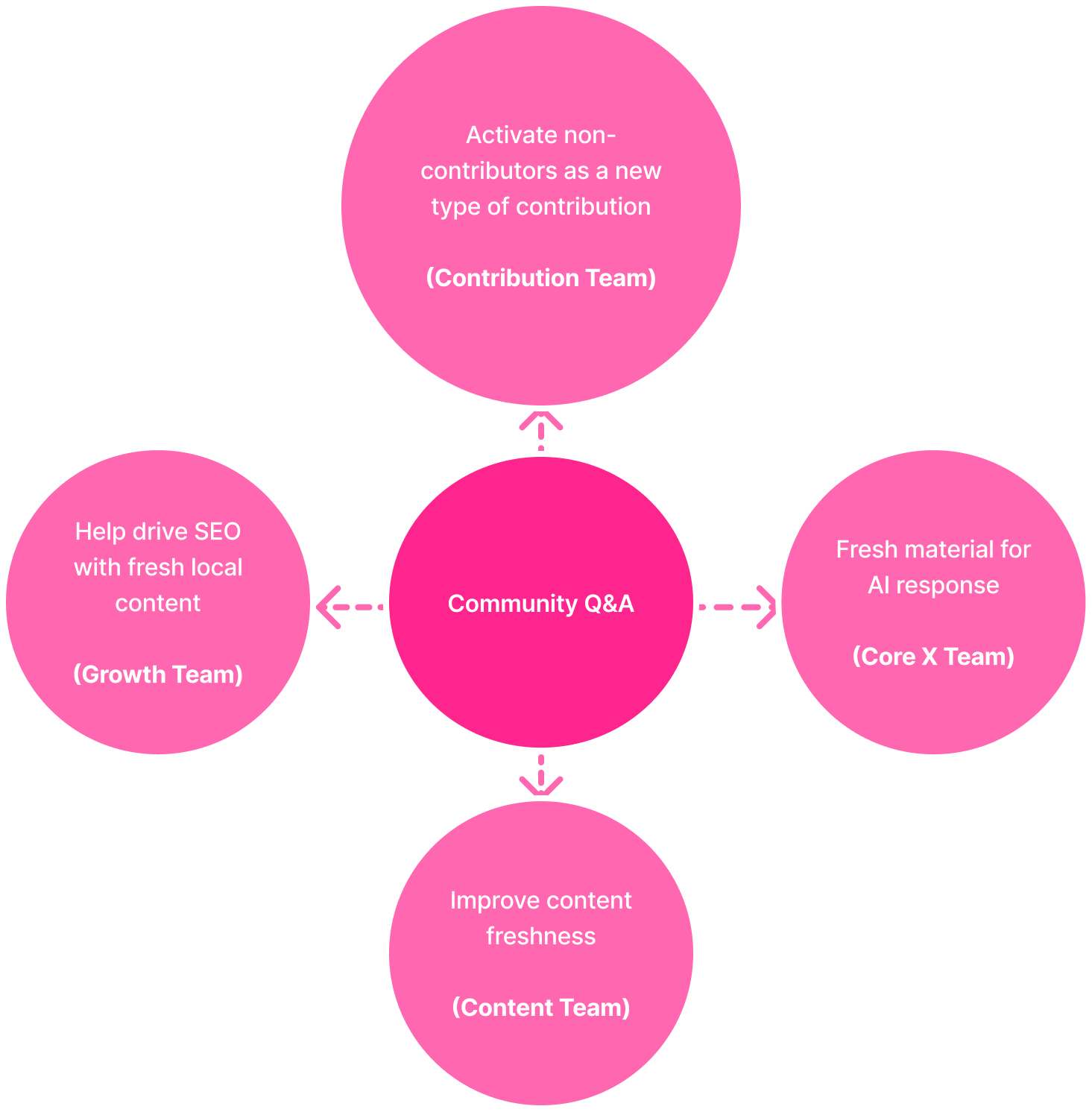
I led the design of Community Q&A from early vision through validation, launch, and growth. The product expanded contribution beyond reviews and developed into a strategic source of fresh local content for search, SEO, and Yelp's AI experiences.
Role
Lead Product Designer
Scope
Product vision, experience strategy, end-to-end product design, and design systems
Team
Contribution, Growth, Core Experience, Trust & Safety
Timeline
2024–2026
Impact at a Glance
~30K
questions each month
40K+
answers each month
~7K
new contributors activated monthly
8M+
monthly impressions
~2×
the one-year retention of review contribution
The Opportunity
Reviews could not answer every local question
People often came to Yelp with needs that reviews could not resolve: a recommendation for a specific situation, help comparing options, or advice that depended on local experience. Search queries already revealed this unmet intent, but users had no direct way to ask the community.
Yelp also needed new contribution formats that required less effort than writing a review and could keep local content current.
The opportunity was to turn unanswered intent into a community exchange without making Q&A feel detached from the rest of Yelp.
Turning an idea into a shared vision
My group PM first introduced the Community Q&A initiative in conversation. I translated that early idea into a vision deck showing how Q&A could live within Yelp's existing ecosystem, support several teams, and grow sustainably rather than becoming an isolated feature.
As the sole designer, I owned the complete experience from MVP through launch and growth.

The Product Evolution
We earned the right to scale
Instead of launching a complete Q&A platform at once, the team tested the initiative in stages. I translated each stage into the product experience and used the results to identify the next design opportunities.

Stage 1
Would people ask?
We placed example questions and answers within search results, where unmet intent already appeared. The first test produced a question-asking rate above the team's assumption and made asking the second most common interaction with the module after scrolling.

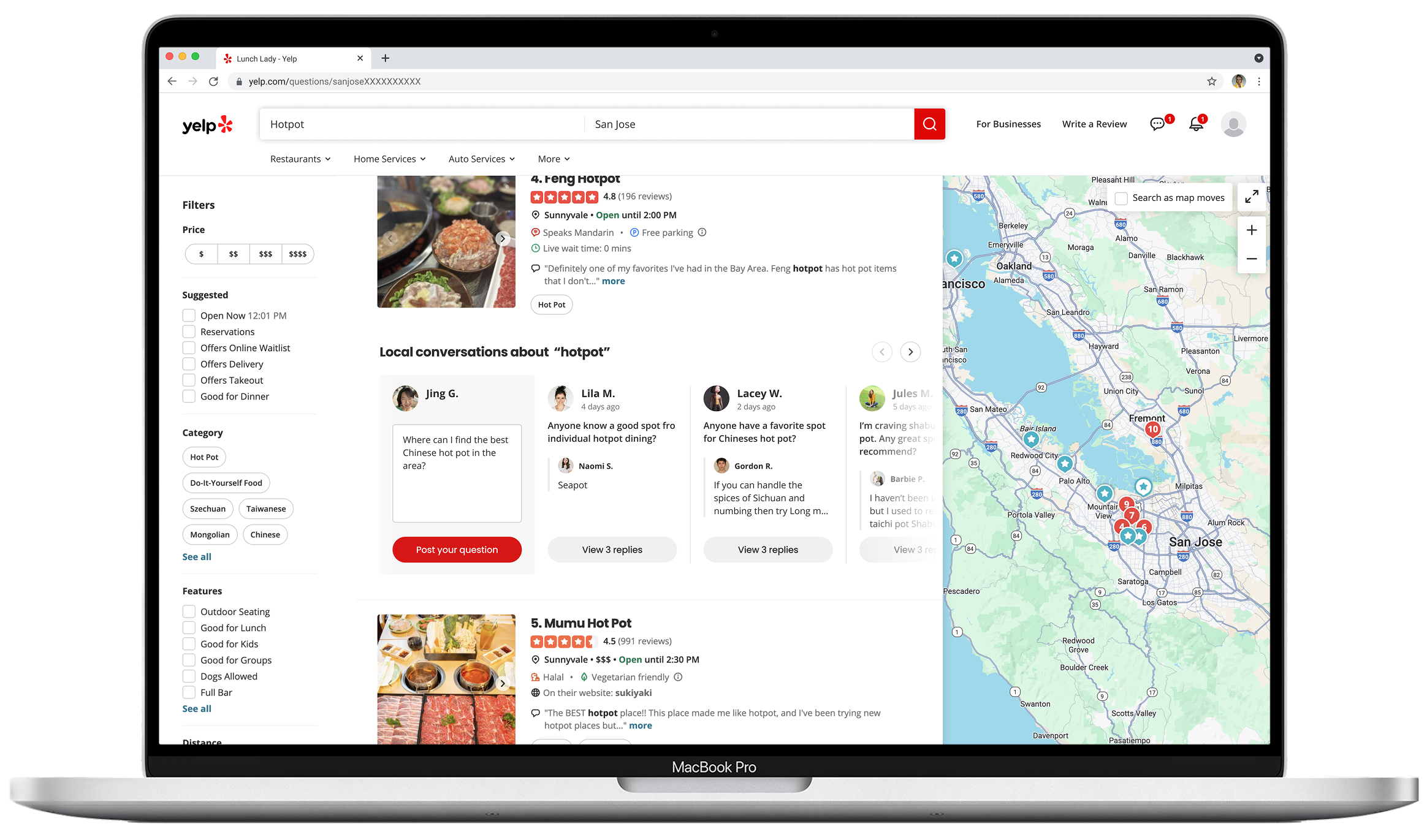
Carousel of Q&A pairs relevant to the search (v1)

Standalone question unit on SERP (v1)
What I learned
Asking felt natural when it continued the user's search rather than starting a separate journey.
Stage 2
Would people answer?
We surfaced relevant questions on Home and after review submission. In an early test, about 500 people contributed roughly 1,000 answers in 20 days. More than half of the questions received an answer, and spam remained minimal.

Q&A carousel on Home, prompt users to scroll and answer

Questions on post review screen, relevant to the review the user just wrote
What I learned
Relevance and timing mattered more than introducing a large standalone destination.
Stage 3
Could the exchange sustain itself?
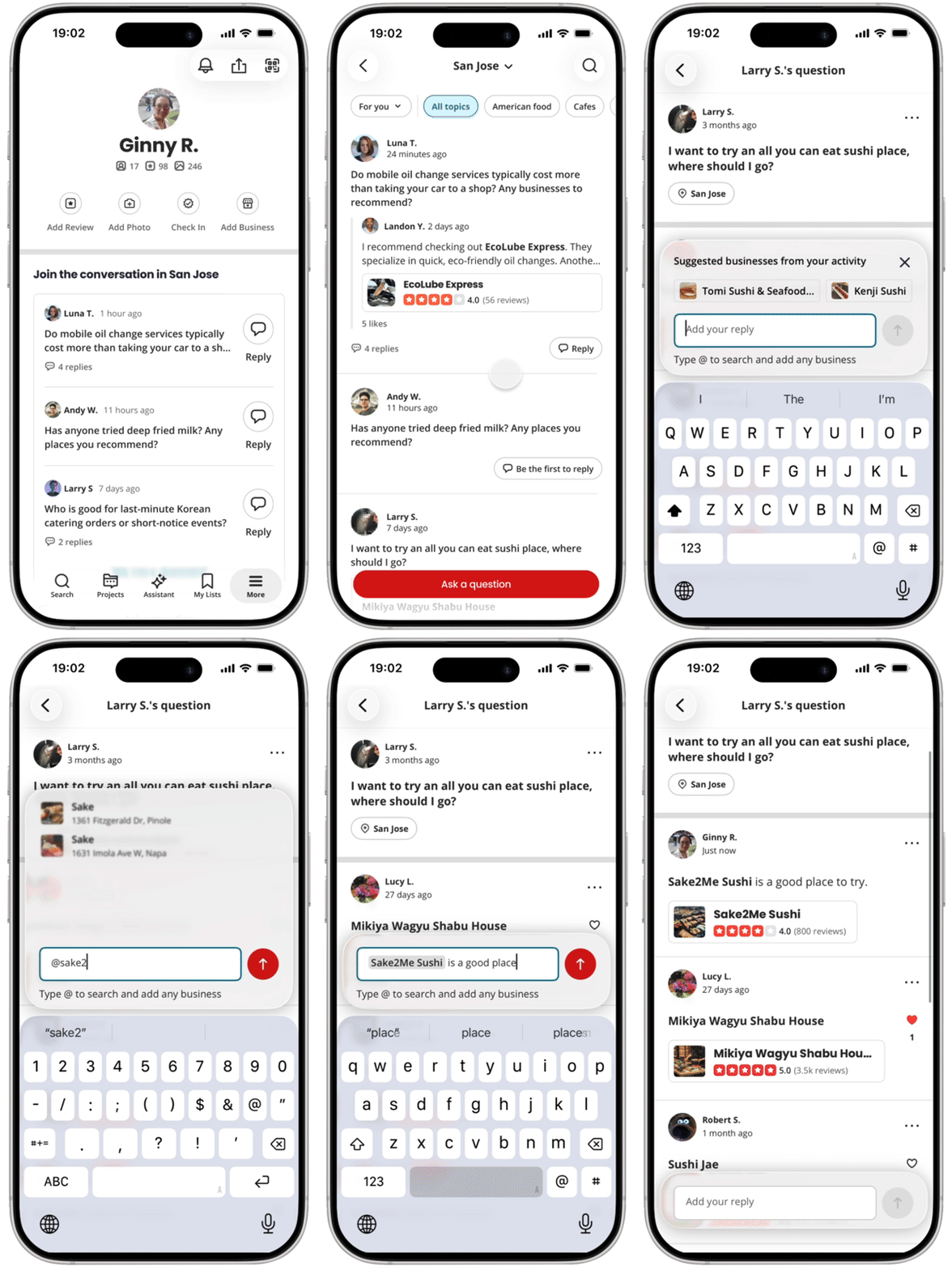
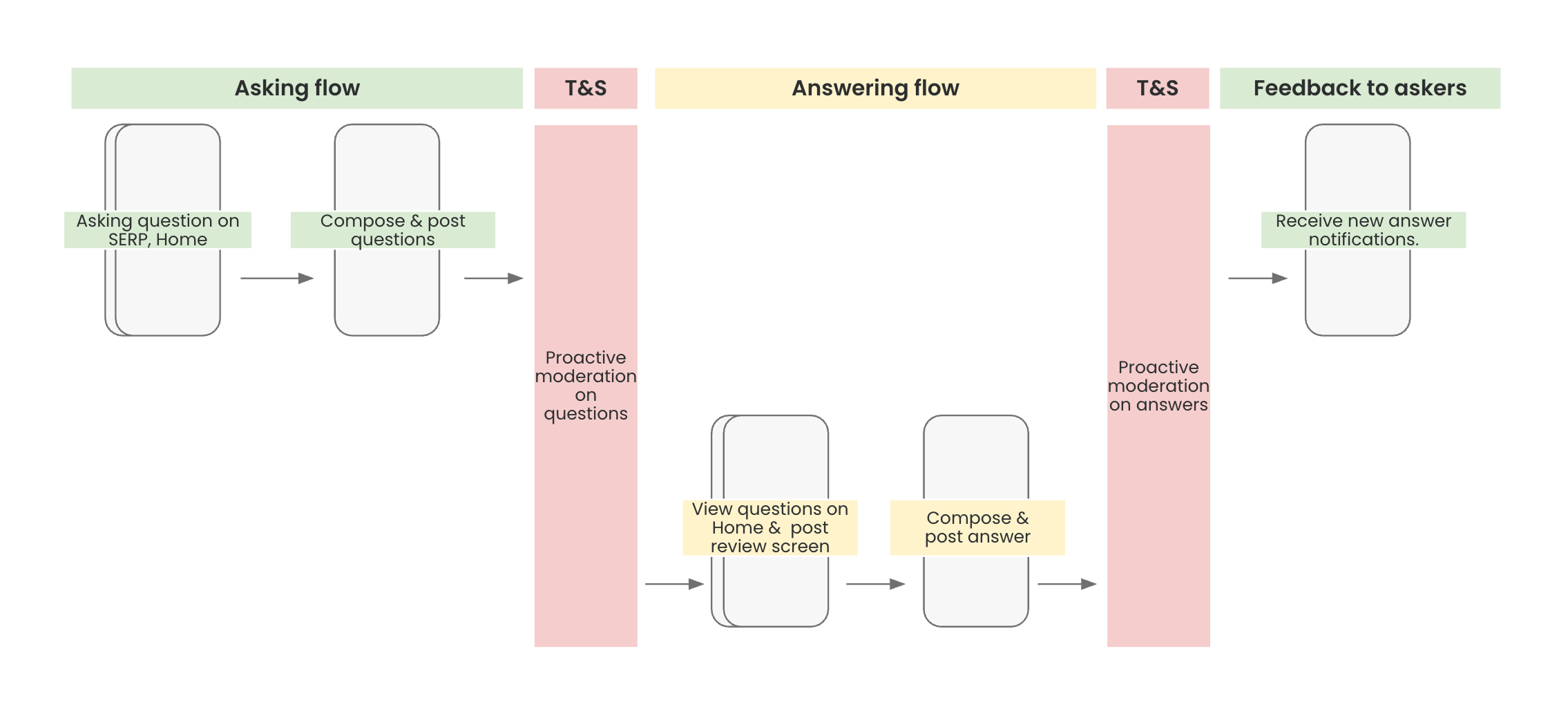
After validating both sides, we launched live asking and answering, added moderation and feedback mechanisms. Community Q&A became a connected ecosystem rather than a single feature.
Three Design Moves That Shaped the Ecosystem
A new community behavior had to work across Yelp
Community Q&A introduced Yelp's first user-to-user conversational experience. The challenge extended beyond designing the asking and answering flows. We needed to meet people with the right invitation across Yelp, bring those paths into a shared neighborhood destination, and make participation feel intuitive within the existing Yelp ecosystem.
I designed the complete experience across distributed entry points, the neighborhood hub for discovery, a personal hub for content ownership, and the interactions that reduced friction throughout the journey. I also worked with partner teams to earn placement on high-value surfaces such as Home and SERP, where Q&A had to demonstrate enough value to justify limited space.
Design Move 1
Match Each Surface to the User's Intent
People arrived on Yelp with different levels of intent. Someone refining a search was ready to ask a specific question. A contributor visiting the Me Tab was more likely to answer. Someone browsing Home might prefer to read an interesting local discussion.
I designed Q&A units around those differences instead of repeating the same module everywhere.
- Search turns unresolved intent into a question.
- The Me Tab makes relevant questions easy to answer.
- Home highlights popular discussions that invite people to read before asking them to contribute.


Why it mattered
Each surface gave Q&A a role that matched the reason people were already there. This helped the product reach askers, answerers, and readers without requiring them to seek out a new feature first.
Design Move 2
Bring the Exchange Together in a Neighborhood Hub
Distributed entry points helped people discover Q&A, but the experience also needed a clear home. Without one, questions and answers could feel like isolated modules scattered across Yelp.
I designed a dedicated neighborhood-level hub where people could ask questions, answer neighbors, browse discussions, and read curated local content. Entry points across Yelp led back to this shared destination, giving the exchange continuity and making the breadth of community activity visible.


Why it mattered
The hub turned separate contribution moments into a neighborhood resource. It gave readers a reason to explore, contributors a place to return, and the product a foundation that could grow beyond individual placements.
Design Move 3
Make Participation Easy and Useful
The ecosystem depended on asking and answering interactions that felt natural inside Yelp's established product language.
For asking, I designed a flow that recognizes question-like searches and helps people turn them into complete questions without starting over. For answering, I introduced assisted business suggestions and inline tagging so contributors could add useful context and connect recommendations to Yelp business pages.
I later added lightweight reactions and notifications so contributors could see when their answers helped someone. These feedback mechanisms supported return participation without adding the complexity of a full social conversation model.


Why it mattered
The interaction patterns reduced the effort required to contribute, made answers more actionable, and gave contributors a reason to return.
Designing the Ecosystem
Community Q&A now connects search, Home, contribution surfaces, profiles, notifications, business pages, and Yelp Assistant. I established reusable patterns that helped these experiences work as one system while giving partner teams a consistent foundation for expansion.
Outcome
A new contribution channel with durable participation
Community Q&A grew into a meaningful part of Yelp's contribution strategy:
- Approximately 30K questions and more than 40K answers per month
- Nearly 7K new contributors activated monthly
- More than 8M monthly impressions from approximately 3M users
- Approximately 40% one-year contributor retention, compared with 20% for reviews
- Less than 1% of sampled questions and about 1% of sampled answers classified as junk or nonsense
The work demonstrates how I lead ambiguous design opportunities: make an early idea tangible, show how it fits the broader ecosystem, build alignment across teams, and evolve the experience as the product reaches scale.
Reflection
The smallest pilots made the largest strategic decisions possible. Testing asking and answering separately gave the team confidence to invest while showing where Q&A belonged within Yelp's existing behavior.
The hardest design problem was integration. Q&A needed prominent placement on Home and search results, but every surface had competing priorities and established patterns. Making the value visible and designing within Yelp's existing language helped the feature earn space without feeling attached from the outside.
Scale then changed the problem again. After launch, success depended less on adding entry points and more on answer relevance, content quality, feedback, and contributor retention. Staying close to the product helped the design mature from a set of flows into an ecosystem.